EXCALIBUR aims to transform the study and preservation of a sensitive and important part of cultural heritage. By creating user-friendly, powerful, and affordable digital tools, the project will empower a new generation of professionals—including archaeologists, bioanthropologists, museologists, conservators, historians, and scholars—to access advanced technology, opening up new possibilities for research, education, and the protection of irreplaceable cultural artefacts.
EXCALIBUR applies its advanced tools and methods to four specific levels of cultural heritage objects and contexts linked to burial excavations and findings.
This approach supports the study, conservation, restoration, and knowledge generation across the four layers:
Burial sites, excavations, and surroundings
Tomb structures and burial decoration
Artefacts, burial findings, traditions and ceremonies
Human and burial remains
From Lab to Field: Toolkits in Pilot Sites
EXCALIBUR provides open-source, cost-efficient digital tools based on AI/ML, Digital Twins and eXtended Reality.
Designed with and for archaeologists, bioanthropologists and conservators, these toolkits are implemented and tested in four pilot use cases.
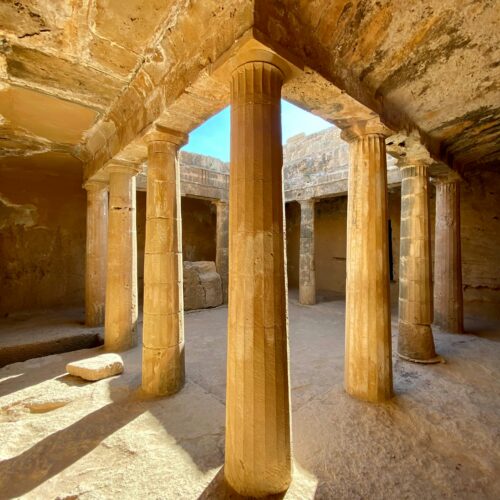
Tomb of the Kings complex
The Tombs of the Kings is a 3rd-century BC UNESCO World Heritage Hellenistic necropolis in Paphos, Cyprus, facing critical structural risks, including erosion and tectonic activity. EXCALIBUR will apply modern technology (9 TKs) for the holistic preservation of this external site (SL1: Burial sites, excavations, and surroundings), moving beyond traditional archaeological tools and photogrammetry.
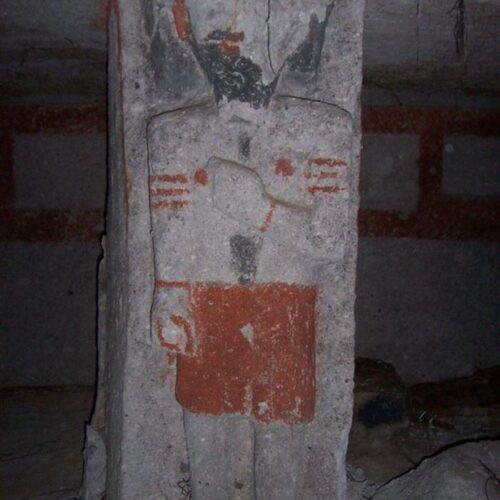
A funerary monument in Sulky, Sardinia, Italy, with a unique Punic tomb (5th c. BC) noted for its strong ties to Egyptian culture, featuring painted decoration and a sculpted pillar. The challenge involves the documentation and conservation of fragile elements, including the severely decayed wooden sarcophagus and the red and black wall paintings.
This Use Case focuses on the detailed analysis and conservation of fragile tomb structures and decoration (SL2: Tomb structures and burial decoration; SL3: Artefacts, burial findings)
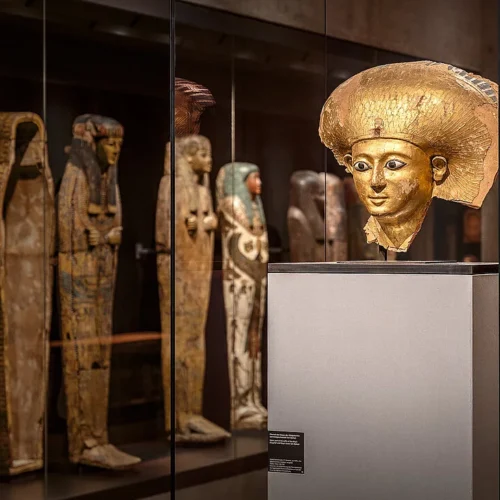
SMAEK in Munich, Germany, curates one of the world’s most important collections of ancient Egyptian objects, featuring over 3000 items in a funerary context, including 11 complete mummies and 40 complete coffins.
By integrating existing data (like archive documents and 250 3D models) with new CT scans and digital recording, EXCALIBUR will validate tools for massive digitization, knowledge organization, and advanced analysis of museum artifacts and human remains (SL3, SL4), by enhancing the study and accessibility of museum collections using AI and advanced digital techniques.
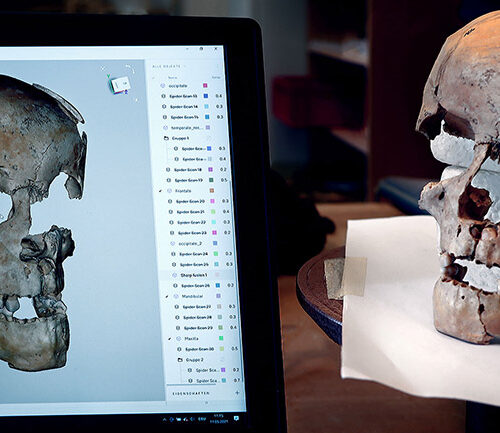
The DUTH Bioarchaeological Collection houses the skeletal remains of over 6,000 individuals from Greece, representing a unique biocultural record dating from the archaic period (6th c. BCE) to the post-medieval period (1500 AD). Building on existing ancient DNA and isotopic analysis, this UC will validate the Comprehensive Toolkit for Bioarchaeology (TK7). The methodology integrates 3D scanning and CT scanning procedures to create accurate digital replicas of ancient bones for non-invasive analysis and paleopathological examination.
This use case focuses on developing standardized digital tools for the advanced scientific study of human remains (SL4: Human and burial remains)
The project delivers user-friendly, open-source and cost-effective digital solutions using AI/ML, Digital Twins and XR technologies to transform the conservation, restoration, and knowledge of burial sites, findings, and human remains
Burial sites, excavations, and surroundings
Tomb structures and burial decoration
Artefacts, burial findings, traditions and ceremonies
January 2026 – The EXCALIBUR project has successfully conducted its Initial User Workshop as part of Work Package 3 (WP3), marking a critical milestone in the
The EXCALIBUR project participated in the webinar: “The European Collaborative Cultural Heritage Cloud in Action: Join us to explore the latest update”, which was organised
On 14 January 2026, EXCALIBUR was presented during the ECHOES webinar for German-speaking communities, hosted by the Austrian National Library (Österreichische Nationalbibliothek). The online event
The Directorate General for Research and Innovation (RTD) organises the event: “The European Collaborative Cultural Heritage Cloud in Action: Join us to explore the latest
Under the coordination of the interdisciplinary team of the Brain, Health & Virtual Reality (BHV) Research Group [1], the kick-off meeting of the EXCALIBUR project
The EXCALIBUR consortium welcomed the positive results of the evaluation with great enthusiasm. The interdisciplinary research project EXCALIBUR was evaluated together with 32 other proposals