EXCALIBUR in the DG RTD webinar for ECCCH

The Directorate General for Research and Innovation (RTD) organises the event: “The European Collaborative Cultural Heritage Cloud in Action: Join us to explore the latest update” [1], on Monday 1st of December, 2025, from 14.30h until 16.30h CET (online).

Complementing the Cultural Heritage Cloud call 2025 webinar on 30 June, the Directorate General for Research and Innovation would like to invite you to a new webinar focused on presenting the 10 new tools projects for the European Collaborative Cloud for Cultural Heritage.

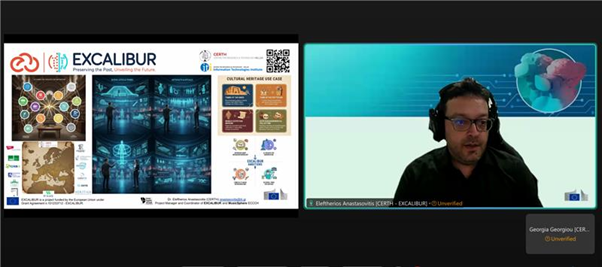
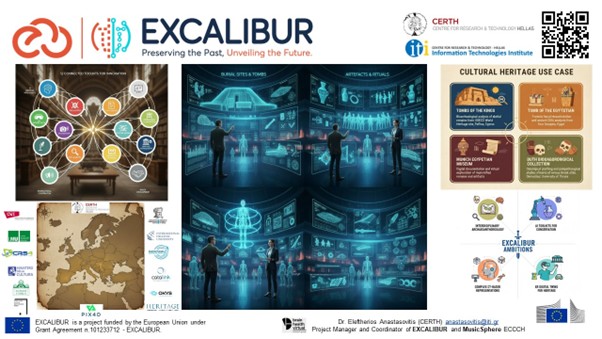
The EXCALIBUR project is among the 10 new tools projects and will be introduced by Dr. Eleftherios Anastasovitis, member of the Coordinator team of the Brain, Health & Virtual Reality (BHV) Research Group [2], at CERTH-ITI. Dr. Anastasovitis will explain the EXCALIBUR project, the technical challenges, and collaborations in the context of the ECCCH ecosystem. We will be glad to meet you online. 

The Directorate General for Research and Innovation is the Commission’s department that is responsible for EU policy on research, science and innovation, with a view to help create growth and jobs and tackle our biggest societal challenges.

EXCALIBUR’s kick off meeting

Under the coordination of the interdisciplinary team of the Brain, Health & Virtual Reality (BHV) Research Group [1], the kick-off meeting of the EXCALIBUR project took place in Thessaloniki, Greece. Over a two-day intensive agenda on October 23-24, 2025, the consortium of the EXCALIBUR project met in person at the Centre for Research and Technology Hellas.

The initiation of the project included the overall presentation of the EXCALIBUR, the initial description of the four (4) use cases, and the challenges of the twelve (12) toolkits and methods. The Project Officer of EXCALIBUR provided the guidelines for the successful development and completion of the project. In addition, representatives of the ECHOES mother project introduced the ECCCH ecosystem [2] and welcomed our project.

The EXCALIBUR work plan extends 42 months, and the activities of the project are clustered into thirteen (13) work packages. The technical activities of the project are grouped into four (4) main thematic structures, with WP2 focused on the technical collaboration and clustering with the ECCCH ecosystem, while WP3 focuses on establishing the need analysis and the framework design. WP4 and WP5, as well as WP7 and WP8, address the scientific innovations of the project on advanced study, conservation, and restoration works based on digital twins of burial CH. WP6 and WP9 are dedicated to the interoperable platform architecture design and integration of scientific outcomes on the ECCCH infrastructure. WP10 to WP12 focused on the test project pilots, use cases demonstration activities, open call for funding support to third parties, and training on the innovative solutions of the project. WP13 is aimed at dissemination, communication, and exploitation activities to promote the project outcomes and contribute towards technical standards for interoperability. Finally, WP1 resources are allocated for the project coordination.

After a deeper analysis of the project, the consortium planned the next steps for the technical progress of the project as well as the main guidelines for communication and dissemination of EXCALIBUR. Our common target is the successful development of the project, with the maximum societal and scientific impact. In this direction, EXCALIBUR will collaborate with the ECCCH ecosystem for early adoption of best practices, early knowledge transfer, and to ensure the compliance of the results with the ECCCH infrastructure and framework. The EXCALIBUR project prioritised the setup of its visual identity and online presence.

EXCALIBUR succeeds funding

The EXCALIBUR consortium welcomed the positive results of the evaluation with great enthusiasm. The interdisciplinary research project EXCALIBUR was evaluated together with 32 other proposals under the HORIZON-CL2-2024-HERITAGE-ECCCH-01-05 topic: “A European Collaborative Cloud for Cultural Heritage – Innovative tools for the study, conservation and restoration of heritage objects” [1]. The EXCALIBUR received an overall evaluation score of 14.5 out of 15.0, managing to be the one of the two proposals selected for funding. At the same time, it is one of the 10 selected proposals of the call “A European Collaborative Cloud for Cultural Heritage – 2024 (HORIZON-CL2-2024-HERITAGE-ECCCH-01) ” out of a total of 145 proposals.

The EXCALIBUR project: “Advanced toolkits for interdisciplinary and enhanced study, conservation, and restoration in burial excavations and findings” seeks to leverage the ECCCH infrastructure to develop and implement a set of innovative tools and methods [2]. The project focuses on creating digital twins of cultural heritage objects, related to burial excavations and findings, providing enhanced capabilities for the study, conservation and restoration of cultural heritage. By addressing the gaps in both research and practice, as well as in stakeholder engagement, EXCALIBUR aims to transform how bioarchaeological findings are studied, shared, and interconnected with relevant artefacts, sites, and burial traditions, fostering a deeper understanding of past populations, while contributing to the vision of ECCCH.

The EXCALIBUR consortium consists of four (4) research centres (CERTH, CWI, CRS4, ECOE), three (3) academic partners (LMU, DUTH, IHU), three (3) SMEs (OKYS, CTL, PIX4D), and four (4) Cultural Heritage (CH) organisations (HEMO, ICOMOS, SA, SMAEK). As such, EXCALIBUR builds a very strong team of researchers, developers, associations and organisations related to the need of the project, for whom the issue of the study, conservation and restoration of heritage objects is of importance. In addition, EXCALIBUR will provide financial support to third parties of CH, through an open call.

The EXCALIBUR project is Coordinated by the interdisciplinary team of the Brain, Health & Virtual Reality (BHV) Research Group [3] of CERTH-ITI. It began in October 2025 and its duration is 42 months. EXCALIBUR is glad to contribute in the Cultural Heritage Cloud ecosystem [4].