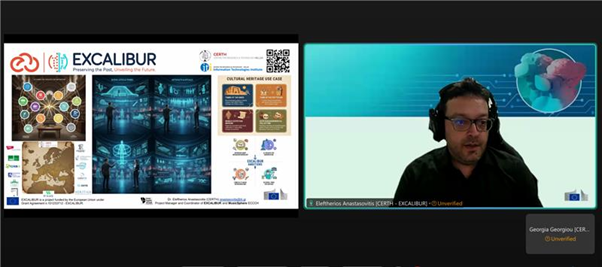
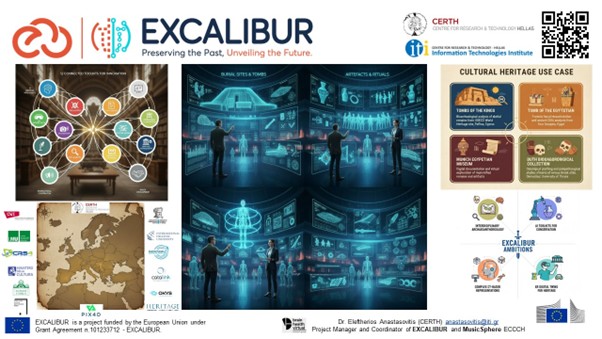
January 2026 – The EXCALIBUR project has successfully conducted its Initial User Workshop as part of Work Package 3 (WP3), marking a critical milestone in the project’s mission to revolutionize the digitization, study, and conservation of burial cultural heritage.
Bringing Together Interdisciplinary Expertise
Co-led by the Eratosthenes Centre of Excellence (ECoE) and the Heritage Management Organisation (HEMO), the workshop brought together cultural heritage experts, archaeologists, anthropologists, conservators, and project partners from across Europe. The primary focus was to define user requirements for digitizing and conserving burial excavations, findings, and human remains, aligning these needs with the overall scope of the EXCALIBUR project.
Why This Workshop Matters
The Initial User Workshop represents the foundation of Task 3.2 (Interdisciplinary user requirements and analysis in burial CH), a crucial component of the project’s implementation plan outlined in the Grant Agreement. This task ensures that the technological solutions developed by EXCALIBUR are firmly rooted in the real-world needs of cultural heritage professionals who will ultimately use them.
According to the project framework, this workshop serves multiple strategic purposes: (i) identifying the expectations and requirements of end-users, (ii) stimulating creative thinking about potential benefits from EXCALIBUR’s technological tools, and (iii) gathering input from diverse specialists including anthropologists, archaeologists, museologists, conservators, curators, and historians.
Key Partner Contributions
The workshop showcased the collaborative nature of the EXCALIBUR consortium:
- ECoE and HEMO (Workshop Co-Leader): Coordinated the session and will prepare the draft structure for Deliverable D3.1, allocating responsibilities among partners
- CERTH (Project Coordinators): Provided coordination guidelines and best practices for successful WP3 task execution
- DUTH, IHU, SMAEK: Presented preliminary needs and requirements from their respective cultural heritage contexts
- All Partners: Engaged in round-robin discussions to outline their planned contributions to the deliverable
Moving Forward: A Living Framework
The workshop’s outcomes will directly feed into Deliverable D3.1 (State-of-the-Art in study, conservation, and restoration in burial CH, user requirements, and technological challenges), which will be structured as a living, online document. This collaborative approach ensures that all partner expertise, from 3D scanning and CT-scan analysis to AI-powered restoration planning, is integrated into a cohesive framework.
By mid-January 2026, ECoE will share an indicative timeline for the development and submission of D3.1, ensuring that the project stays on track with its ambitious goals.
The Bigger Picture
This initial workshop is the first in a series of demonstration and user engagement events planned throughout the EXCALIBUR project lifecycle. As outlined in the Grant Agreement, these workshops form a crucial part of the project’s interpersonal communication strategy, gathering structured feedback from the User Group and cultural heritage professionals to refine the project’s innovative tools and methodologies.
The insights gathered will directly inform the development of EXCALIBUR’s advanced toolkits for digitization, AI-based analysis, and conservation planning, ultimately contributing to the European Collaborative Cloud for Cultural Heritage (ECCCH) ecosystem.
Stay Connected: Follow our progress as we work to preserve the past and unveil the future of burial cultural heritage. Join the conversation on our social media channels for updates on upcoming workshops and project milestones.
Contact: For more information about WP3 activities, reach out to Dr. Konstantinos Roussos at the Eratosthenes Centre of Excellence (konstantinos.roussos@eratosthenes.org.cy).